– Relative clauses with « that », « which », « who », « where »
– Taboo game using relative clauses
WEEK2 : American / British culture
– Quiz book. Choose a quiz topic and do the quiz together.
– Create a quiz about your home!
– Check quiz questions for correct question construction.
WEEK1 : Warm-up: Show drawing of a groundhog and discuss
« Groundhog Day » and French and American cultural difference.
Questions format: Question word – Auxiliary – Subject – Verb
Game: « One minute challenge »: write topics on the board. Throw a paper ball at the board to choose a topic. In groups, speak for one minute about the topic. Each group member should ask one follow-up question (using the correct question word and structure).
Discussion: what are the similarities and differences between the American teenager’s routine and yours? Are there any aspects of American life that you prefer? Is there anything in the video that you find weird or funny? Basketball review game.
WEEK3 : What do you really know about the USA?
Warm-up: Name the country represented by each flag.
Introduce « English-speaking countries » video project.
Learn some names and flags of English-speaking countries.
« Concentration » review game for country names and a few bonus categories.
– Vocabulary: rabbit, easter bunny, egg, chick, Easter, hop, wiggle your ears, wiggle your tail
– « Bunny, Bunny, Chick » game
WEEK2 :
– Popsicle stick leprechaun (craft)
– « I’m a little leprechaun » song
Review vocab from before the holiday.
– « I’m a little leprechaun » song
– Saint Patrick’s Day treasure hunt activity
– Saint Patrick’s Day coloring activity.
– Begin « prepositions of position » : UNDER, ON, IN, BEHIND, IN FRONT OF, BETWEEN
WEEK 1 : School holidays
FEBRUARY 2021 : MY HOUSE
WEEK4 : School holidays
WEEK3 : Rooms of the house vocabulary (3)
– Vocabulary review games
– Rooms of the house game. « in » for location.
o Where’s the ____ ? Is it in the _____ ? Yes it is. No it isn’t.
WEEK2 : Rooms of the house vocabulary (2)
– Rooms of the house song,
– Flashcard games
– New words: window, door, chimney, garden, hall
– Drawing activity. Draw a house. Is it big or small? What color is it? How many windows / doors does it have? Does it have a bedroom, bathroom, etc. ?
WEEK1 : Rooms of the house vocabulary
House ; Apartment ; Bedroom ; Bathroom ; Living Room ; Dining Room ; Kitchen ; Hall ; Garden ;
« The House Song »:
Flashcard games
Draw or make a play-doh house
JANUARY 2021 : WINTER SEASON
WEEK4 – in person :
« Freeze Dance » song; Winter clothes song ;
Review games for winter and Three Little Kittens vocabulary
Make a cardboard kitten. Use stickers for eyes, nose and buttons. With a marker, draw some whiskers, a mouth, some boots and a hat. Use yarn or a fuzzy pipe cleaner to make a scarf.
WEEK3 – in person :
« winter clothes » vocabulary review games: Simon Says, Memory
Crafts/Activities: Invent a crazy food combination like in the song “broccoli yogurt”. Draw a pizza with your favorite toppings. Thanksgiving turkey craft:
OR Discussion about your dream house and everyday life
Weird accommodations and « amenities »: Have you ever stayed in unique or odd accommodations? Which amenities are essential when you are traveling? Which ones can you go without?
Example of weird accommodations: the Idaho Potato Hotel
Which features of a house are essential, in your opinion? Which are not essential?
Homework: Describe your dream home OR research and describe an unusual home.
WEEK2 : New topic: House and Home.
Go over « modal verbs of deduction » homework.
Discussion: Super Bowl
– Expressions with « house » and « home »
– What does « home » mean to you?
– Jason Momoa Super Bowl Commercial :
Grammar point: Causative constructions: « to have something done » or « to get something done ». « Home improvement » text with exercises.
Homework: Phrasal Verb « to put off » / « to find out »
and depending on your group… watch the Mr. Bean video and give advice using the « causative construction » OR tell about a time when you made home improvements.
WEEK4 : TALK AND WALK Or 6-Minute English: The Science of Loneliness
https://www.bbc.co.uk/learningenglish/features/6-minute-english/ep-201126 Listen to the recording and read along with the transcript. Can you give some examples of « pinch points »? How do you cope with pinch points when they happen? What is the difference between solitude and loneliness, according to the researcher? Do you agree with her claim? In the video, they mentioned Mauro Morandi. His boat broke down on an island and he decided to stay there–alone–for 31 years. If it had happened to you, what would you have done?
Communicative context: – this phrasal verb is often used at the end of formal letters or emails as a polite way of asking for a reply or arranging further communication. For example: I look forward to hearing from you soon.- it is also used in spoken communication and informal writing. In that case, we often use the continuous form of the verb. For example:Mark: « See you at lunch tomorrow? »Cathy: « Looking forward to it! »
Homework:
– Write a sentence with the following phrasal verb: to make up
BREXIT video https://www.youtube.com/watch?v=TOX3SCsJ0Ew The video is a news report from January 1st, 2021. It shows different people’s reactions to the end of the Brexit transition period. Watch the video: Who reacted positively to the change? Who reacted negatively? Useful vocabulary from the video: – a new dawn = a new beginning « It’s a new dawn: a new era on our relationship with the EU. » – to dance around a topic = to avoid speaking about something « In his New Year’s address, the Prime Minister danced around Brexit. » – in drips and draps = little by little, in small amounts « New details are emerging in drips and drabs. » – to swap = to trade, to exchange « UK and European firms can continue trades and swaps. » – the eleventh hour = the last possible moment « The governments reached an agreement at the eleventh hour. »
Homework : What are your New Year’s Resolutions? Make a list.
Homework : Ask questions about any difficult point in the text.
Continue discussion of « A Christmas Memory » by Truman Capote. At its heart, this is a story of childhood friendship. Talk about a friend you had as a child.
Read dialogue aloud on page 4-5 (Buddy and his cousin go to Mr. Haha Jones’s shop).
Practice word stress for emphasis: the words in italics in this dialogue should be longer, louder and higher-pitched.
Christmas song: « White Christmas » by Lady Gaga.
Homework: What is your favorite Christmas song? Suggest a song or carol for next week.
Types of homes: cottage, bungalow, apartment/flat, semi-detached, detached, terraced, palace, castle, studio. What are the features of each type of home? Which features of a home are essential to you? Which type of home do you prefer? What is a typical French home?
Video: James Bond visits Buckingham Palace.
Homework: Describe a famous home. When was it built? Who lives there? What features does it have? etc.
WEEK2 : Go over « reported speech » homework. More « reported speech » practice.
Begin topic: « house and home »
What is the difference between house and home?
Expressions with « house » and « home »
Homework: Tell about a time when you made home improvements. Did you ask for help or DIY?
WEEK1 : « TALK AND WALK » OR January week 4 lesson
JANUARY 2021 : HEALTH & WELLNESS
WEEK4 : « TALK AND WALK » OR To the doctor’s office
Discuss homework and review 2nd conditional. Video: « Friends »: Rachel’s visit to the eye doctor:
Grammar point: Indirect reported speech- Read the statements from the video. Can you change them to indirect speech?
Discuss similarities and differences between French and American health systems.
– Santa Cruz de Islota, off the coast of Columbia, is the most densely-populated island in the world.
– Budelli island has only one inhabitant, who has lived there alone for more than 30 years.
Watch the video and read the text. Which island would you rather live on? Which lifestyle would be better for your health? Video about Santa Cruz de Islota:
Passive voice practice: Put the following sentences and ideas from the video in passive voice:
– Fisherman used the island for shelter from storms.
WEEK1 – Kelsey: Listen and read article (LEVEL 5): « New Year’s Resolutions Difficult to Keep » (click on the link: you can listen at different speed s and read the article again) https://breakingnewsenglish.com/1501/150102-new-years-resolutions-l.html Common new year’s resolutions are about health, money, food, friends, hobbies and the world. We make resolutions to quit, change, or start something. For example: – save money – quit a bad habit – get fit – lose weight Discussion: Which resolution is the easiest to keep? Which is the most difficult? Why? Homework : The January Topic is Health and Wellness. What does being healthy mean to you?
WEEK1 – Klaudia:
Speaking
How did you celebrate Christmas? New Year’s Eve?
What are your New Year’s Resolutions?
What is your favo(u)rite Christmas tradition?
How did you celebrate Christmas/New Year’s Eve when you were a child?
How would you organize your perfect winter holiday/vacation?
FINALLY, let’s speak about Present Continuous. Even though Present Continuous is a present tense, it can allude to the future.
I am seeing Martha in town tomorrow.
We use the present continuous tense for definite future arrangements. Often, it doesn’t really matter if we choose ‘be going to’ or the present continuous. In the following example, there is really very little difference in meaning:
I‘m going to the cinema tonight.
I‘m going to go to the cinema tonight.
We use the present simple tense in two cases. First, we use it for a timetabled event in the future, like public transport or the start of a class:
My train leaves at six tonight.
His class starts at 9am tomorrow.
Second, we use it after certain words, when the sentence has a future meaning. These words are: before / after / as soon as / until / when:
I’ll call you when I get home.
She’s going to study after she finishes dinner.
Please drink some water as soon as you complete the race.
Part 3: We have had a lot of holidays recently. Now is a good time to review topics from past lessons. This will be different in each class: preterite, modals, parts of the body, etc…).
Function: a long or continued action in the past, often interrupted by another past event.
APRIL 2021
WEEK1 : Listen to travel stories.
Check -ED pronunciation. Introduction to past continuous.
Airport vocabulary.
MARCH 2021 :
WEEK4 : Modes of transportation.
Past -ED: what are the 3 pronunciations of the suffix -ED?
Homework: mark the pronunciation of each regular verb in the travel story you wrote.
WEEK3 : TALK & WALK OR Exercises with prepositions of place.
Read or listen to a text about the « Upside Down House » and describe a picture. The upside-down house is a popular attraction in many cities. Have you ever visited one? What attractions do you visit when you travel?
Homework: Irregular verbs: say / said / said and see / saw / seen AND ?
WEEK2 : Presentations and discussions of famous homes. Review house and home vocabulary.
Grammar point: Prepositions of place
– Under/below
– Over/above
– On
– In
– Behind
– In front of
– Next to
– Between
– Opposite
Monday 6:30PM Homework: Study the words on this list for next time. Irregular verbs: read / read / read (remember pronunciation change!) and run / run / run.
Wednesday 4:30PM Homework: Describe a room in your house. Say where objects are located using prepositions of place. Irregular verbs: pay / paid / paid and put / put / put
Week1 : Article (LEVEL 4) « New Year’s Resolutions Difficult to Keep » (click on the link : you can listen at different speeds and read the article again) https://breakingnewsenglish.com/1501/150102-new-years-resolutions-4l.html Common new year’s resolutions are about health, money, food, friends, hobbies and the world. We make resolutions to quit, change, or start something. For example: – save money – quit a bad habit – get fit – lose weight Homework: What are your new year’s resolutions? Make a list. Irregular Verbs: Get – Got – Got Give – Gave – Given
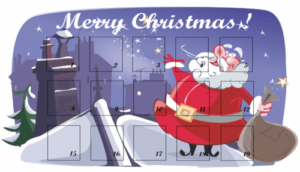
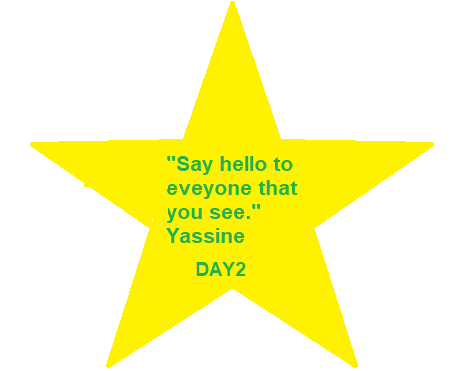
Each day you can try to answer a new question or solve a new challenge in English. Please, send us your resultsbefore the 1st of January and you will get a reward 😉
Envoyez nous par email votre calendrier avec toutes vos réponses, les photos demandées etc. avant le 1er Janvier 2022 et vous serez récompensé 😉
Created during By The Way 2020 Teens classes – starter on Tuesday, April the 21st
Last update : Tuesday, May 12th at 8pm
The plot :
In the group, there is a form of inequality which causes a dispute because their music is not compatible. Caroline and Kelly like playing one type of music, while Sandrine and Alexa have a different idea. Lucy is alone, stuck in the middle. She is concerned about the dispute and does not feel comfortable to say what she thinks.
There is another student (or teacher) at the school who exacerbates this conflict within the group. They want to break up the group but, in the end, the girls realise that they are stronger together.
Characters:
Caroline: She plays piano. She likes classical music. She is a little shy and very happy. She’s an optimist. She has black hair and brown eyes. She is Korean. She is medium height.
Kelly: She plays guitar. She likes pop music. She is very patient and honest. She always says what she thinks. She has red hair and green eyes. She has white skin and she is tall.
Sandrine: She plays drums. She likes rock ‘n roll! She is impatient and hyperactive. She has lots of energy. She has purple hair and blue eyes. She has white skin and she is short.
Lucy: She plays flute. She is intelligent, shy and often sad. She has blond hair and blue eyes. She has white skin and she is tall.
Alexa: She plays electric guitar. She likes rap. She is outgoing. She has black hair and blue eyes. She has brown skin and is tall and skinny.
Ben: The student who exacerbates the conflict. He is a singer. He is irritable and curious.
The story :
This story is about five girls who study at Gallagher Elite High School of Music in London. Gallagher is unlike other schools in the region. The Principal rules very strictly and always ensures that the uniform looks perfect.
The girls are in a school music class. They are playing different styles of music.
Caroline : « Kelly, your music is very nice. I think our music goes well together. »
Kelly : « Thank you, your music isn’t bad either. Let’s try to play together if you want? »
They play a pop song together on piano and guitar.
Sandrine hearing the music : « I don’t really like the sound of your music, girls. »
Alexa : « I agree with Sandrine. It’s terrible! »
In the meanwhile, Lucy is alone. Ben goes over to her, and suggests they start a group of their own. Alexa and Sandrine see Lucy with Ben and ask her: “Why have you abandoned us?”
Lucy says to the girls: “I have left you because you ignored me, did your own thing and left me alone for so long.”
Caroline and Kelly join, intrigued, “What’s happened?” “What is it?”
Ben responds, defensively, “Stop, leave us alone.”
L’activité principale de l’association est l'organisation d'activités ludiques en langue anglaise ayant pour but de favoriser au maximum la compréhension et la pratique de l'oral.